

Most DevRel initiatives fail because they start too late or measure the wrong things. We sat down with Nicolas Grenié — 10+ years building developer ecosystems at Typeform, 3scale, and Mailjet — to deconstruct what actually works. This is the operational guide for founders building developer-facing products who want to grow adoption beyond their initial network
Full read here 👇
“DevRel cannot compensate for poor DX. If your sign-up flow is too long or your environment setup is broken, no amount of community management will save you.”
Nicolas Grenié, DevRel specialist
01. Fix the foundation first: community cannot rescue broken DX
DevRel is not a marketing function. It is the intersection of engineering, product, and community — and it only works when the developer experience underneath it is already solid. The triad has two sides: Developer Experience (the internal friction layer: onboarding, documentation, SDKs, API connectivity, time to first Hello World) and Advocacy & Community (the external distribution layer: community growth, adoption, brand awareness). Neither works without the other, but DX must come first.
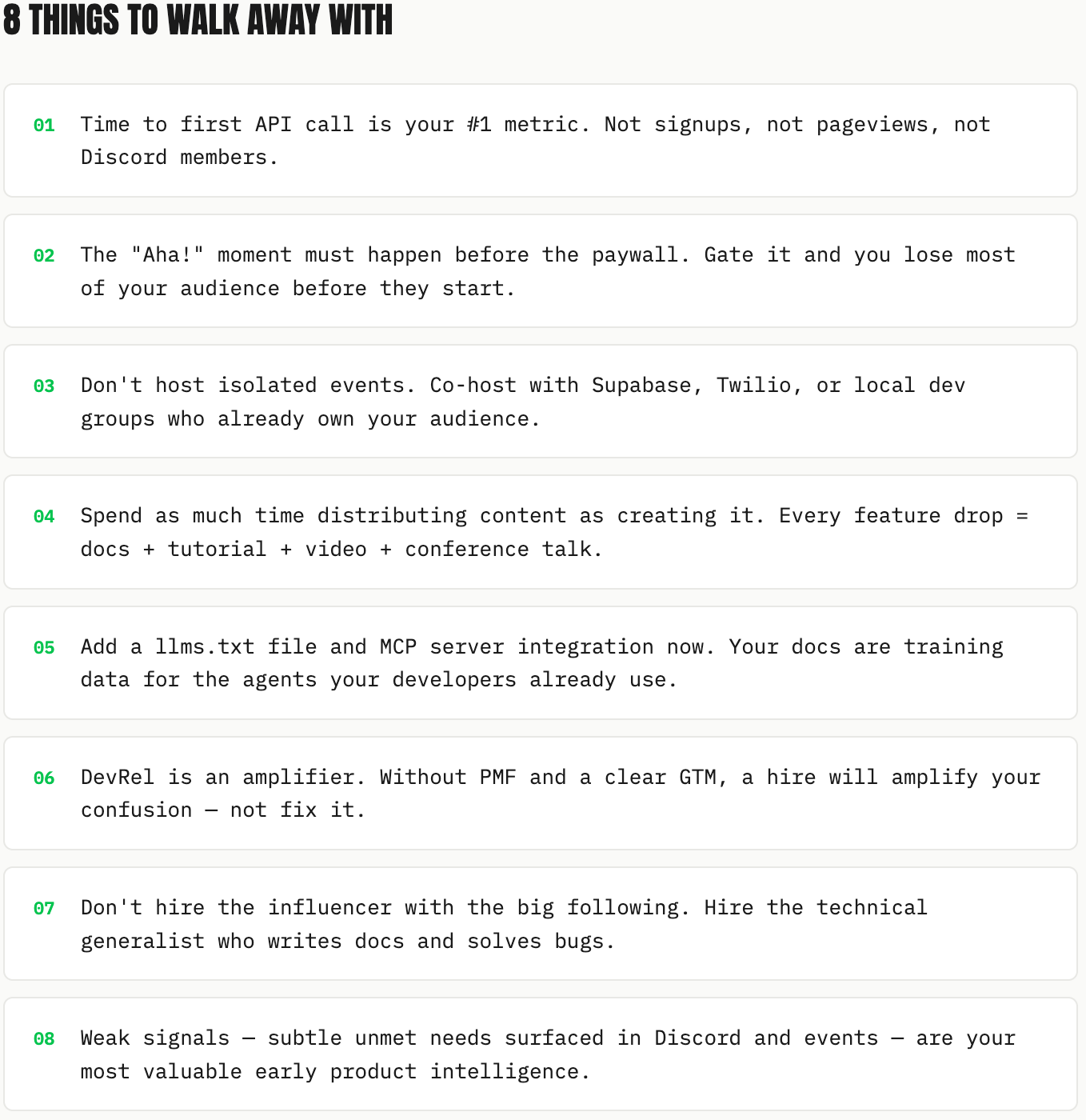
Your single most critical metric is time to first API call — not account creation, not email confirmed, not dashboard visited. The benchmark to study: Vercel’s template hub. One click, GitHub auth, deploy. Every additional step beyond that is a drop-off point you chose to build into your experience.
The “Aha!” moment — the first time a developer actually sees your product do something useful — must happen before the paywall or complex login requirements. If you gate the moment of value behind a form, you have already lost most of your audience before they ever start.
02. Your ICP determines your entire content strategy
You cannot build a content strategy without first deciding who writes the check. DevRel content splits into two fundamentally different modes depending on your sales motion — and mixing them produces content that resonates with nobody.
Bottom-Up vs. Top-Down : pick your motion
→ Bottom-Up: The Vibe Coder
Target: DevOps engineers, junior devs, hands-on builders. They want deep-dive technical tutorials, code samples, GitHub-first content. They are hungry to test tools and love memes. The developer adopts, then champions upward.
→ Top-Down: The CTO / VP Ops
Target: decision-makers who control budget. They value “hot takes”, ROI case studies, and strategic efficiency over implementation details. The executive approves, then mandates downward.
Pick your motion and commit. The three execution pillars:
- Advocacy (conferences, meetups, workshops),
- Community (Discord moderation, ambassador programs, hackathons), and
- Content (walkthroughs, video series, certifications), all serve your ICP.
Define the ICP first, then decide which pillars matter most for your motion.
03. Don’t build community from zero, borrow existing audiences.
One of the most expensive mistakes in early DevRel is hosting isolated events with no existing audience. Nobody is coming to your "MyCoolCompany Meetup" just for the free pizza. The ecosystem hack: don't build from scratch. Partner with Supabase, Twilio, or local dev groups. Co-host meetups using their reach. Leverage trending technologies that already have built-in audiences. This is not cutting corners, it is how the best DevRel programs actually scaled in their first 12 months.
“Good content is not enough. Spend as much time promoting the content as you did creating it.”
DevRel is also cyclical, not episodic. When a new feature ships, the right response is not one post. It is a full cycle: documentation, step-by-step tutorial, video walkthrough, conference talk. Every piece of content should map to one of the four engagement modes: Educate, Enable, Inspire, or Feedback, and no piece should be left to die after a single distribution push.
04. AI rewrites the rulebook, the agent is now the user.
AI is reshuffling the cards. In an AI-first world, your developer experience needs to be as much about agents and LLMs as it is about human developers. The implications are concrete and immediate — this is not a future consideration.
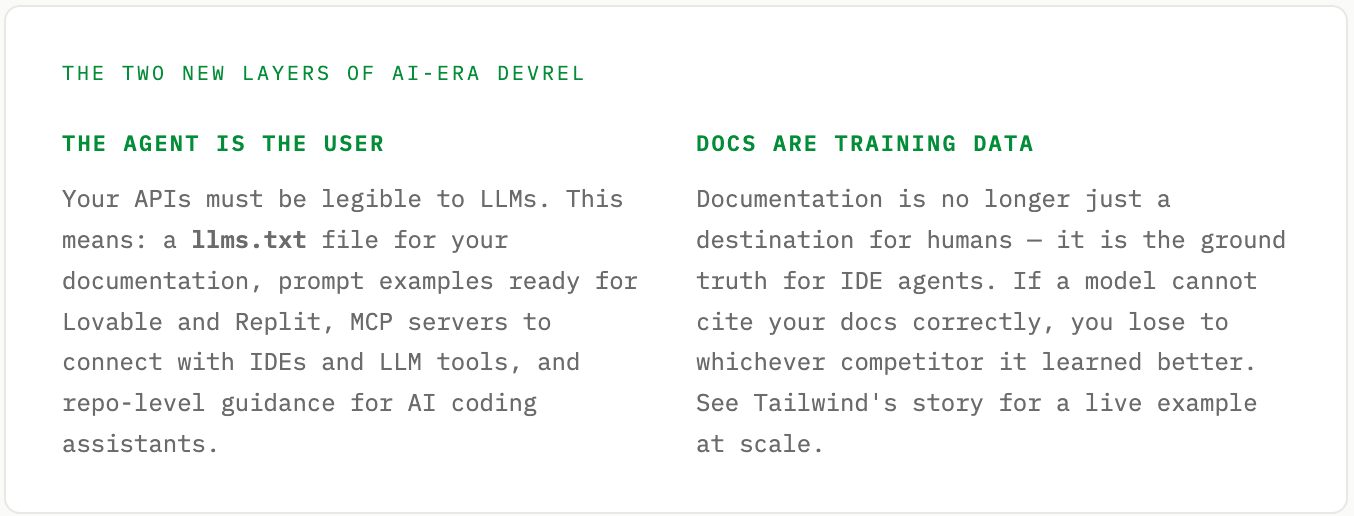
The old playbook, post a blog, do a conference talk, grow Discord, is necessary but no longer sufficient. The new layer is technical infrastructure: making your product legible to the machines that now mediate how developers discover and integrate tools.
05. Measure ROI in three phases, not one dashboard
DevRel ROI is highly tangible but often delayed. The mistake is measuring it in a single dashboard or expecting revenue-linked metrics at month two. There are three distinct phases, and conflating them is how DevRel teams lose their budget.
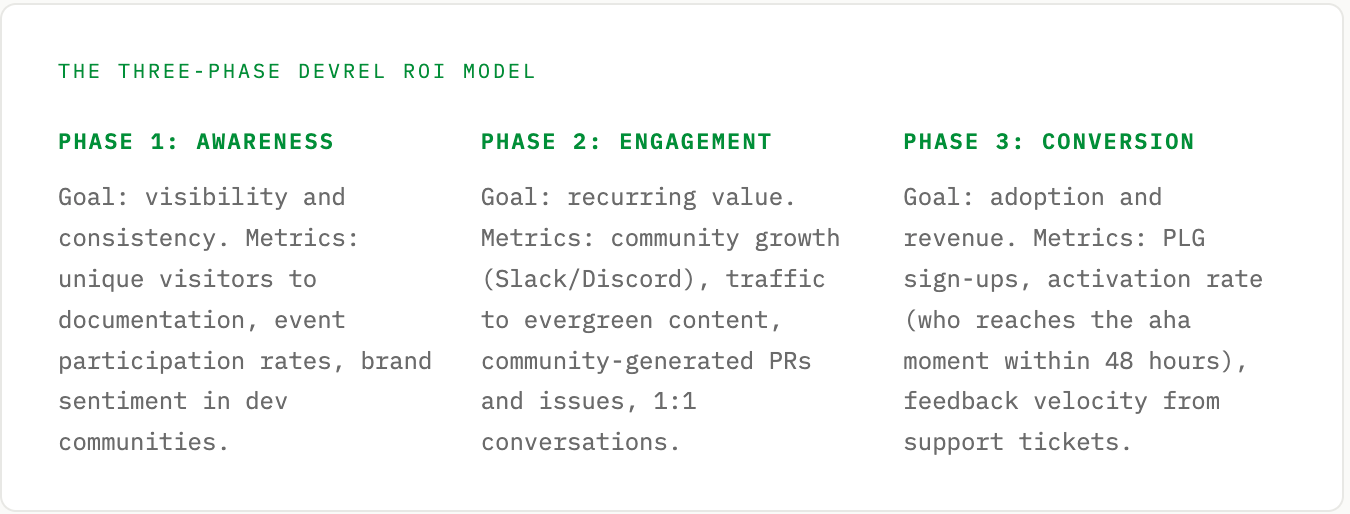
The most underrated signal across all three phases is what Nicolas calls “Weak Signals”, subtle emerging needs that haven’t yet appeared in mainstream data. The channels you animate (events, Discord, 1:1s) are intelligence infrastructure. Always be scanning across four pillars: Tech Stack (what tools do they use?), Friction Points (what are the deal-breakers?), User Workflow (how do they actually work?), and Knowledge Gap (what are they missing to succeed?).
06. Hire for technical depth, not audience size
Hiring for DevRel is notoriously difficult because it sits at the uncomfortable intersection of engineering, marketing, and product. The biggest mistake early-stage founders make is the Influencer Pitfall: hiring the person with the largest following instead of the person who can drive adoption.
DevRel is an amplifier, not a foundation. If you don’t have a clear GTM strategy or product-market fit, a DevRel hire will simply amplify your lack of direction. There is a clear scaling sequence:
The DevRel Hiring Strategy Map
→ 0–100 Users: Founder-led advocacy. Write docs, post on HackerNews, answer GitHub issues yourself.
→ 100–500 Users: External leverage. Contractors, technical ghostwriters, “Power Users” who already use and love the product.
→ Post-PMF: First full-time hire. A “Technical Generalist” who can code, write, and speak. Not an influencer — an engineer who communicates.
→ Scaling: Specialists: Technical Writer, Community Manager, Developer Advocate by geo. Only after a proven motion.
“If you don’t have a clear GTM strategy or Product-Market Fit, a DevRel hire will just amplify your lack of direction.”
When you do hire: look for hands-on technical depth, systems thinking, someone who writes docs and solves bugs. Not someone with a large Twitter following who will “spread the word.” A big audience without adoption mechanics will produce noise, not growth.
Operator’s Take : What this changes for you right now
At pre-seed, you should not have a DevRel hire. You should be doing founder-led DevRel yourself: writing the documentation, answering GitHub issues, showing up in Discord, posting on HackerNews. The question is not “should I hire DevRel?” but “is my developer experience worth advocating for?”
Fix your time-to-first-API-call before you think about community. If a developer lands on your product and hits friction in the first five minutes, no community programme will save your activation rate. Once you’re past 100 users and approaching PMF, the highest-leverage move is external — contractors, power users, co-hosted events with platforms that already have your audience.
And in an AI-first world, the new table stakes are technical: a llms.txt file, MCP server integration, and documentation that models can actually cite. Add these now, regardless of where you are in the DevRel journey. The window to get ahead of this is closing.